

The content shift that doubled my revenue
Why I stopped teaching and started diagnosing

7 months ago, most of my connection requests came from freelancers and writers. People who wanted to learn how to edit better, write hooks, build an audience.
Today? Founders. Co-founders. Senior marketers at B2B tech companies.
What changed?
I stopped creating content that taught people how to do things themselves, and I started creating content that diagnosed problems and showed what I did instead.
Did my engagement on LinkedIn drop during the transition? Yep. For a few months, it was significantly lower than my baseline.
Did it impact my business? Nope.
In fact, I’m making more month over month than I ever have. Consistently.
This pivot was an intentional move upmarket, so I want to walk you through what I’ve learned along the way.
I was answering downmarket questions
Most service providers are stuck attracting the wrong clients because they’re answering the wrong question.
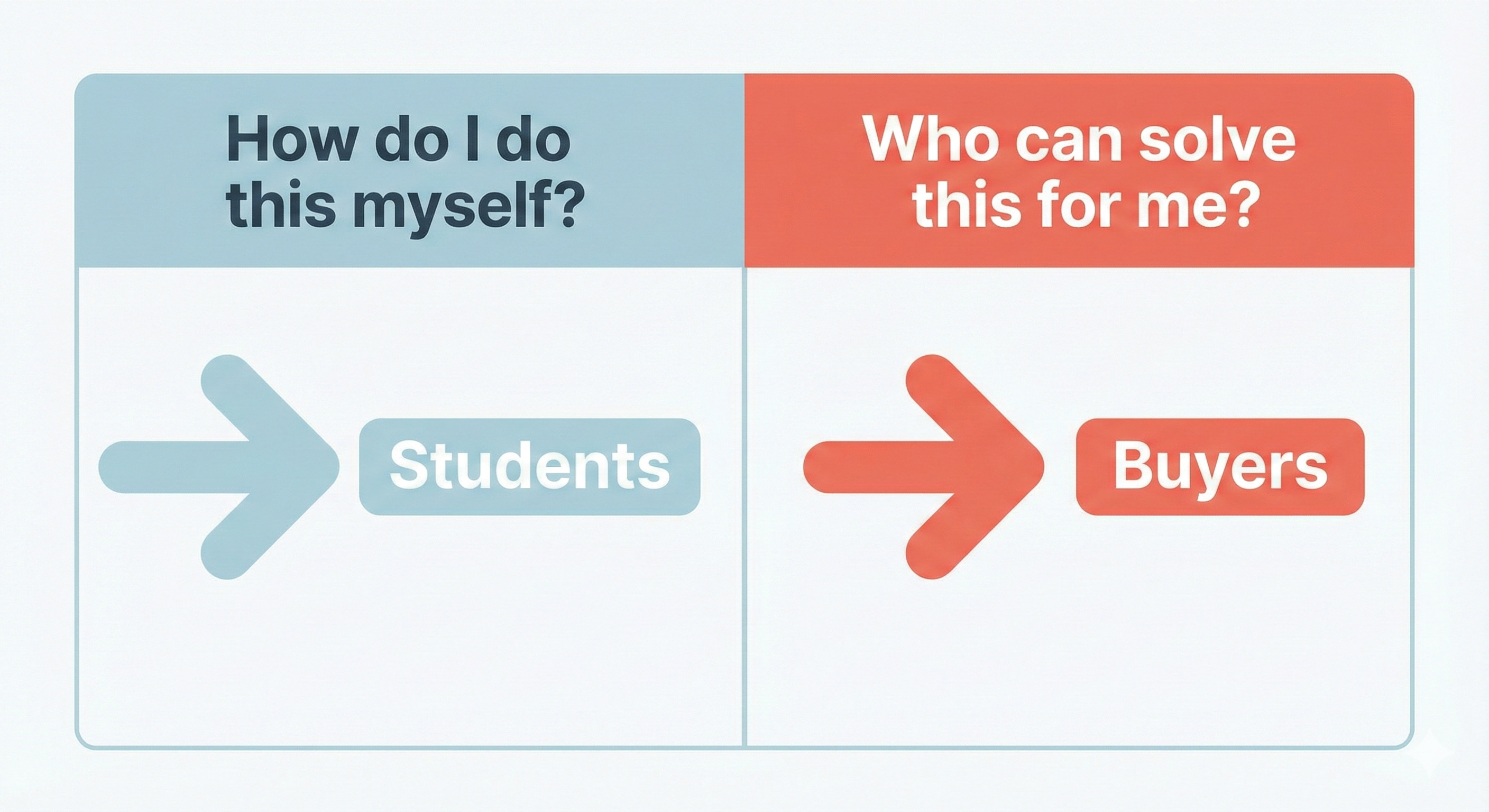
They create content that answers: “How do I do this myself?”
When their ideal clients are asking: “Who can solve this problem for/with me?”
I know this sounds subtle. But it’s not.
It’s the difference between someone booking a discovery call to “pick your brain” and someone booking a call ready to write a check.
When you lead with how-to content like “Here’s my 7-step framework,” “Copy this template,” “Use these 3 tools,” you’re inviting people to replicate what you did. You’re saying: go make it yourself.
And the people who respond to that invitation are people who want to DIY.
They’re not bad people. They’re just not high-ticket buyers yet.
The difference between students and buyers
Look, I actually think people should try to figure shit out on their own first. That’s how you learn. That’s how you build the scar tissue that makes you good at what you do.
I did it. You probably did it. It’s part of the process.
But there comes a point where you’re done fucking around.
You’ve tried. You’ve failed. You know what you need. And now you just want a partner to help you scale.
Those people aren’t asking “how do I do this?” They’re asking, “Who can do this for me?”
They’ve hit the pain threshold where the problem costs more than the solution. They’re optimizing for speed and certainty, not cost. They understand that the right partner is an investment, not an expense.
These are the people who can afford you. These are the people who won’t ghost after you quote your rates.
And the content you create determines which group finds you.
What this looks like in practice
Let me show you what I mean.
One of our clients runs a Demand Gen program. His ideal client is a VP of Marketing at a Series A-B tech company. Before we started working together, his content wasn’t doing anything for him. Everything was coming from referrals.
When we helped him apply our MP3 framework, his content shifted completely. Instead of teaching VPs how to run LinkedIn conversation ads, he started sharing stories like this:
A client asked me to 2x their leads from LinkedIn Ads. They’d plateaued at 10 per month. So I ran an experiment and opened up their conversation ads to a broader, colder audience. My gut said it wouldn’t work, but I tested it anyway.
Result: zero leads for an entire month.
So we adjusted. Went back to a warm audience strategy but loosened the parameters slightly. Added a few more LinkedIn member groups. Kept the warm signals - people who’d been on the website, clicked an ad, engaged with content.
New result: 3 leads in the first 5 days.
Look at what he’s doing here. He’s not teaching VPs how to optimize their own conversation ads. He’s showing them he understands the nuances, he has a process, he isn’t afraid to experiment, and he gets outcomes.
A VP reading this isn’t thinking “great, now I know how to do this myself.” They’re thinking, “This person gets it. They test strategically. They troubleshoot fast. I need to talk to them.”
That’s the difference.
Educational “here’s how to do it yourself” content invites replication. Problem and process-focused “here’s how I’ve solved a problem you’re having” content invites partnership.
Why upmarket clients don’t need tutorials
This is where most service providers get stuck.
They default to educational content because it feels generous. It feels helpful. And it is.
But if your goal is to attract upmarket clients, educational content creates a fundamental mismatch.
Upmarket clients don’t need you to teach them how to do things. They could probably figure it out themselves if they wanted to. But they’re not going to because that’s not where their time is best spent.
They don’t need another tutorial. They need someone who can come in, diagnose what’s broken, and execute.
What they need to see from your content is that you understand the problem they’re facing, you have a proven process to solve it, and you can execute it for them.

Educational content can show the last two (when framed through your process). But it completely misses the first one, and that’s the most important piece.
Because when someone is ready to invest serious money in your services, they’re not looking for information. They’re looking for someone who can articulate their problem better than they can themselves. Someone who makes them think “holy shit, this person gets it.”
That’s what problem-focused content does.
Less engagement ≠ less money (quite the opposite!)
As I said at the start, when I made this shift, my engagement dropped. Fewer “great tips!” comments. Fewer saves. It was uncomfortable.
But over the past seven months, my connection requests have changed completely, my sales calls are significantly easier because people show up pre-qualified, and my revenue has increased month over month.
Not because I’m posting more (I’m posting less frequently).
Not because I’m working harder (I’m working just as hard as I’ve always worked).
Because I’m finally attracting the upmarket, mature buyers who can pay for my high-ticket services.
So if you’re a service provider trying to go upmarket, stop asking yourself, “What can I teach people today?”
Start asking: What problem can I diagnose? What pattern am I seeing across clients? What’s broken that people don’t realize is broken?
When you spend more time diagnosing than teaching, the right people will find you.
Cheers,
Erica
PS. If you’re at $20K+ MRR and ready to standardize your offer, turn your expertise into content that attracts buyers, and build a sales process that doesn’t require custom-scoping every deal, that’s what we do at Duo Consulting.
Yup, checks out. Can also be the difference of a hook that says "If you're a VP Marketing, here's how you can optimize your Linkedin ads" vs "If my VP Marketing asked me to double our leads from LinkedIn Ads, here's how I'd go about it"
This mindset and approach shift is gold! Thank you so much for sharing it!